


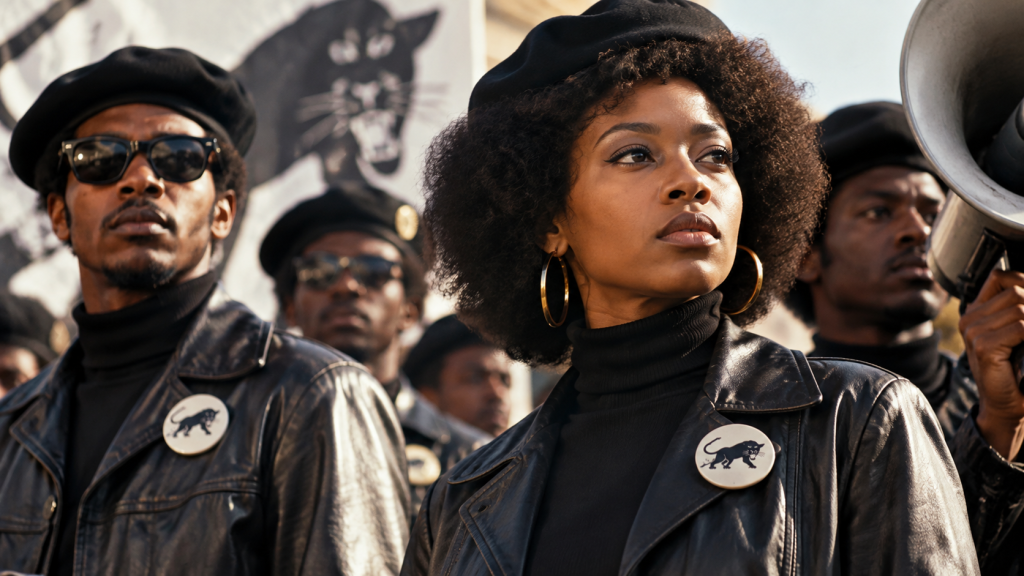
Beyond the berets and raised fists was a movement that fed children, opened health clinics, educated communities and changed the meaning of Black self-determination.
When many Americans hear the words Black Panther Party, the images are immediate. Black berets. Black leather jackets. Raised fists. Armed Black men and women standing unapologetically in the face of a country that had spent generations telling Black people where they could live, where they could sit and how much resistance they were allowed to show.
Those images are real. But they are not the whole story.
Sixty years ago this month, in October 1966, Huey P. Newton and Bobby Seale founded the Black Panther Party for Self-Defense in Oakland, California. What began as an effort to confront police brutality developed into a national organization advocating for Black political power, economic justice, decent housing, education, healthcare and human rights.
This October, Oakland will welcome Panther veterans, scholars, artists, organizers and younger generations for a four-day gathering commemorating the 60th anniversary of the organization. It is an important milestone, but perhaps it is also an opportunity to revisit what we think we know about the Black Panther Party.
Because if all we remember about the Panthers is the fist, we have forgotten the hand that fed the child.
One of the Party’s most significant initiatives began with something remarkably simple: breakfast.
The Free Breakfast for Children Program provided meals to children before they went to school. It wasn’t symbolic activism. Children actually ate. According to the Smithsonian’s National Museum of African American History and Culture, Panther chapters eventually organized free breakfast programs that served approximately 20,000 children every day.
Think about what that meant at the time. Long before the phrase “food insecurity” became commonplace in conversations about poverty and education, Black organizers recognized something fundamental: it is difficult for a child to learn when that child is hungry.
So they fed them.
And breakfast was only part of what the Panthers were building. Over time, the organization developed dozens of what became known as Survival Programs, designed to meet needs that Black communities were telling them were not being adequately addressed elsewhere.
Healthcare became part of that work.
The Panthers established free community health clinics in cities across the country, providing services to people who often had limited access to affordable medical care. They also brought attention to sickle cell anemia, providing testing and education at a time when the disease, despite disproportionately affecting Black Americans, received far less public attention than it does today.
In many ways, they were talking about what we would now call health disparities and health equity decades before those terms became part of mainstream conversations.
They also understood that changing a community required educating it.
The Panthers created educational programs and Freedom Schools, including the Oakland Community School. Political education was central to the organization as well. Newton and Seale’s original Ten-Point Program addressed employment, housing, education, police brutality and other conditions confronting Black communities. Bobby Seale wanted the platform written in language ordinary people could understand because information wasn’t supposed to belong exclusively to academics or political leaders. The people living with the problems needed to understand the issues too.
When you put all of this together, a different picture of the Black Panther Party begins to emerge.
They were feeding children, helping families obtain clothing and food, providing health services, educating communities and assisting people with transportation and other everyday needs. None of this was separate from their politics. It was part of their politics.
Their philosophy was not simply that Black communities should protest the systems they believed were failing them. They also believed communities needed to build ways to care for one another while fighting to change those systems.
That doesn’t erase the militancy of the Black Panther Party. The organization openly advocated armed self-defense, and confronting police brutality was central to its creation. The Panthers were controversial then, and parts of their ideology and tactics remain controversial today.
But history doesn’t require us to choose between those realities.
The Panthers could stand armed against what they viewed as police abuse and wake up early the next morning to cook breakfast for schoolchildren. Both are part of the history.
Another part of that history that deserves more attention is the role of women.
Popular images of the Black Panther Party can make it appear overwhelmingly male, but women became central to the organization and its community programs. Women organized chapters, educated children, distributed food, worked on the Party’s newspaper, operated community programs and held leadership positions. The Smithsonian notes that many local survival programs were led by women.
Their work is another reminder that some of the most important contributions to a movement don’t always produce the photograph that ends up in the history book.
Of course, the story of the Black Panther Party cannot be told without acknowledging the government’s response to it.
The FBI targeted the Panthers through COINTELPRO, a counterintelligence program that used surveillance, infiltration and other tactics against organizations and individuals the federal government considered threatening. The campaign against the Panthers contributed to internal instability and became part of the complicated story of the organization’s eventual decline.
That history also helps explain why, 60 years later, there are still very different understandings of what the Black Panther Party represented.
Were they militant? Yes.
Were they controversial? Absolutely.
Did they believe in armed self-defense? Yes.
But those facts don’t make the breakfasts disappear. They don’t erase the health clinics. They don’t erase the schools, sickle cell testing, food programs or political education.
History becomes incomplete when we remember only the parts of the Black Panther Party that frightened America and forget the parts that fed Black America.
That is what makes this month’s anniversary significant.
From October 15 through October 18, Oakland will host several days of programming commemorating the Black Panther Party’s 60th anniversary. The gathering will include Panther veterans, community organizers, scholars, artists and younger generations. Organizers are also providing sponsored conference access to 1,000 high school students, intentionally making young people part of the conversation about the movement’s history and future.
And maybe that intergenerational piece matters most.
There isn’t much value in saying we want to preserve Black history if we don’t make sure the next generation actually knows it.
Sixty years after the Panthers were founded, some of the issues they organized around sound remarkably familiar. We talk today about food insecurity, health disparities, educational equity, criminal justice reform, affordable housing, community investment and mutual aid.
The language has changed.
The conversations have not disappeared.
None of this means the Black Panther Party should be romanticized or remembered without its complexities. Black history doesn’t need to be sanitized to be celebrated, and it doesn’t need to be perfect to be important.
But it deserves to be told completely.
Because the Black Panther Party didn’t only tell America what Black people were against. Its members spent years showing what they believed Black communities deserved: dignity, safety, food, healthcare, education, housing, economic opportunity and the power to have a meaningful say in what happened in their own neighborhoods.
Sixty years later, perhaps that is the Panther legacy worth revisiting.
The leather jackets made the photographs. The guns made the headlines.
But somewhere before school, a Black child sat down and ate breakfast because members of the Black Panther Party believed that child deserved to be fed.
And that is Black Panther history, too.


