


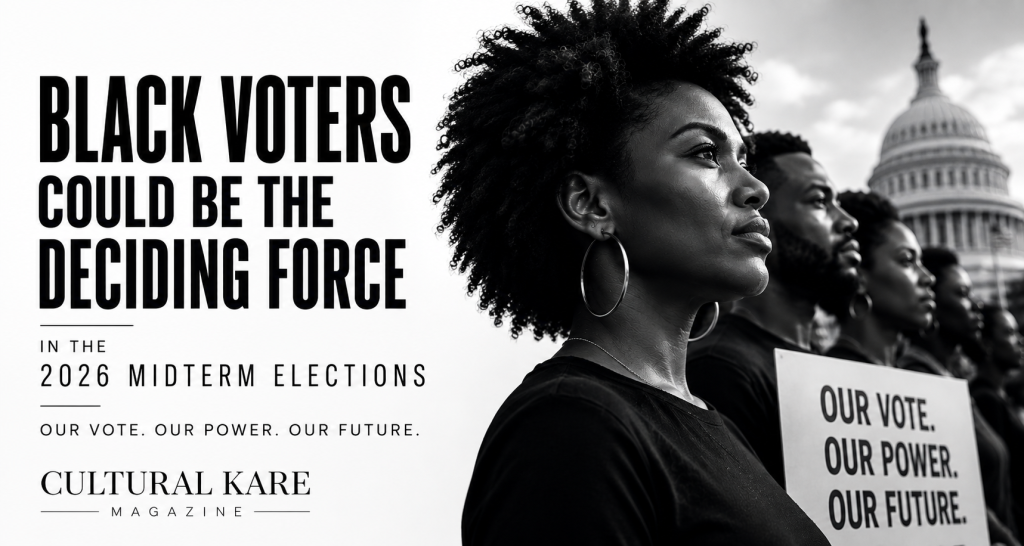
With just over two months until the 2026 midterm elections, one voting bloc is once again becoming impossible for political candidates to ignore: Black voters.
Control of Congress will be decided in November, and closely watched races across the country could come down to which candidates can motivate Black voters to actually show up at the polls.
But this election may also come with a warning for politicians: Black voters aren’t necessarily interested in being taken for granted.
Recent polling and primary results suggest economic concerns, frustration with the political establishment and questions about whether elected officials are actually addressing everyday problems are shaping the conversation heading into November.
The Black Vote Still Carries Enormous Power
Black voters continue to lean heavily Democratic.
A July Pew Research Center survey found 68% of Black registered voters said they would support the Democratic candidate for Congress in their district if the election were held today, compared with 8% who favored the Republican candidate.
But another number may be just as important.
Twenty-five percent of Black registered voters said they were either unsure or would support another candidate.
That uncertainty could matter tremendously in an election where a relatively small number of votes could determine control of Congress.
It’s About More Than Party
For candidates hoping to reach Black voters, the message may need to move beyond party loyalty.
Housing.
Healthcare.
Food prices.
Wages.
Childcare.
The everyday cost of simply living in America.
Those are increasingly becoming the issues driving political conversations.
A new Reuters/Ipsos poll found 47% of registered voters overall identified the cost of living as the single most important factor influencing their vote in the upcoming midterms.
That concern is particularly relevant in Black communities, where families are navigating many of the same affordability pressures while also confronting longstanding economic disparities.
Candidates may discover that simply telling Black voters what’s at stake politically isn’t enough.
Voters want to know what changes when they cast their ballot.
A New Political Test
The changing political landscape is already playing out in Democratic races.
After several candidates aligned with the Democratic Socialists of America scored victories during this year’s primary season, Reuters reports that the movement now faces a major test: whether its candidates can build meaningful support among Black voters in November.
Florida State Representative Angie Nixon offered one possible blueprint.
Nixon defeated retired Army Lt. Col. Alex Vindman in Florida’s Democratic U.S. Senate primary despite facing a significant fundraising disadvantage.
Her campaign gained strong support in Black communities while emphasizing affordability and everyday economic concerns.
The victory demonstrated something political strategists have understood for generations: connecting with Black voters can dramatically change an election.
But earning that support requires more than appearing in Black communities a few weeks before Election Day.
Turnout Could Be the Bigger Story
The question isn’t simply whether Black voters prefer Democrats or Republicans.
It’s whether they vote at all.
That distinction could decide some of the country’s most competitive races.
In Ohio, for example, research presented by the Ohio Legislative Black Caucus Foundation found approximately 603,000 eligible Black voters did not participate in the 2022 midterm election.
The organization estimates that getting even half of those voters to participate this year could be enough to influence a statewide election.
That represents an enormous amount of political power sitting on the sidelines.
And Ohio isn’t the only place where turnout matters.
Georgia, North Carolina and other battleground states have competitive races where Black voter participation could significantly influence the outcome.
Black Voters Are Being Courted — Again
Every election cycle, candidates make their way into Black churches, barbershops, community centers and historically Black neighborhoods.
They talk about representation.
They talk about opportunity.
They talk about the importance of voting.
But many Black voters have increasingly questioned what happens after Election Day.
Are neighborhoods receiving investment?
Are families able to afford groceries and housing?
Are small businesses getting access to capital?
Are healthcare costs improving?
Are schools getting better?
Those questions don’t fit neatly into campaign slogans.
But they may ultimately determine who earns Black voters’ support.
November Could Come Down to Who Shows Up
The 2026 midterms will determine control of the U.S. House and shape the balance of power in Washington for the final two years of President Donald Trump’s current term.
Both parties have enormous stakes in the outcome.
Republicans are working to maintain congressional power.
Democrats are trying to regain it.
And once again, Black voters could find themselves positioned directly in the middle of that fight.
The political question heading into November isn’t simply which party Black Americans will support.
It may be whether candidates have given Black voters enough reason to believe their vote will make a difference.


