


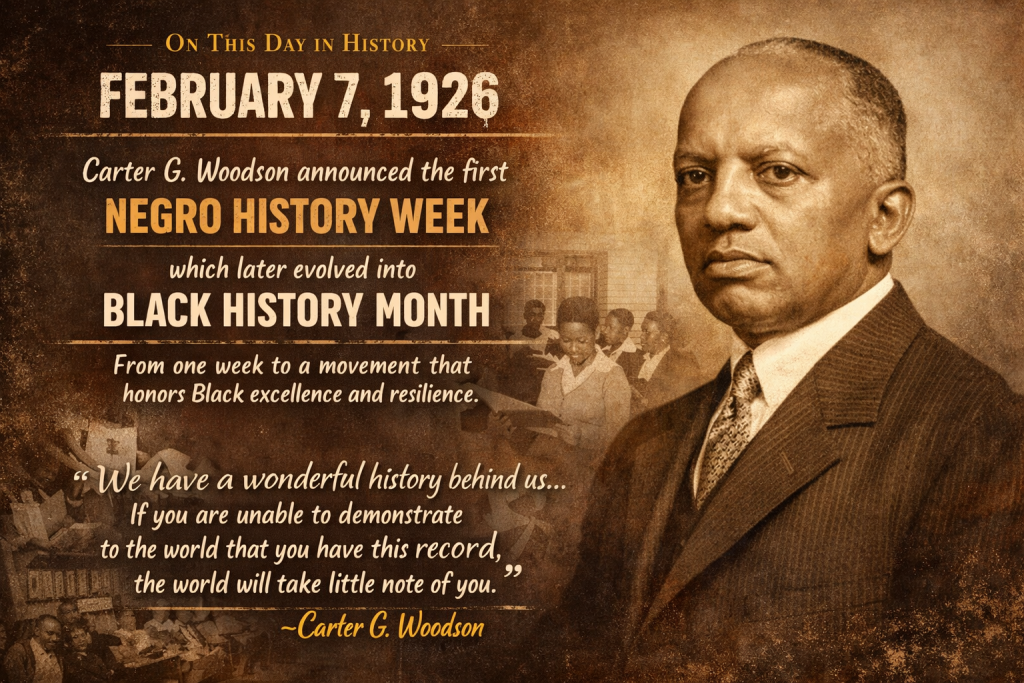
By any measure, February 7, 1926 was a quiet day that sparked a lasting transformation.
On that day, historian Carter G. Woodson formally announced Negro History Week, an educational observance designed to ensure that Black history—long ignored, distorted, or erased—would be studied, preserved, and taught with rigor and respect. Nearly a century later, that single week has grown into what the world now recognizes as Black History Month.
Woodson’s motivation was not ceremonial. It was corrective.
At the time, mainstream American education largely excluded Black contributions to history, science, politics, and culture. Textbooks either omitted Black Americans entirely or reduced their presence to footnotes framed by enslavement. Woodson, a Harvard-trained historian and the son of formerly enslaved parents, understood that omission as both intentional and dangerous.
“If a race has no history,” Woodson once wrote, “it has no worthwhile tradition, it becomes a negligible factor in the thought of the world.”
Negro History Week was conceived as a direct challenge to that reality. Woodson strategically chose the second week of February to coincide with the birthdays of Abraham Lincoln and Frederick Douglass—figures already acknowledged in Black communities—using that familiarity to anchor a broader educational mission. Schools, churches, and civic organizations were encouraged to study Black history not as an aside, but as an essential part of American life.
What made Woodson’s approach radical was not just the creation of the week itself, but the framework behind it. He insisted on scholarship, documentation, and academic legitimacy. Through the Association for the Study of Negro Life and History (now the Association for the Study of African American Life and History), Woodson published journals, curricula, and research that centered Black voices and primary sources at a time when such work was routinely dismissed.
The response was immediate and sustained.
Negro History Week gained traction across the country, particularly in Black schools and institutions that saw the observance as both an affirmation of identity and a form of resistance. Over the decades, as the civil rights movement reshaped national consciousness, the call to expand the observance grew louder. In 1976—50 years after Woodson’s original announcement—the U.S. officially recognized Black History Month, extending his vision from one week to an entire month of study and reflection.
Yet historians note that Woodson never intended Black history to be confined to a single week—or even a single month.
His larger goal was integration: the normalization of Black history as American history, taught year-round and woven into every discipline. The observance was a catalyst, not a container.
Today, Black History Month is recognized globally, with institutions, corporations, schools, and governments engaging in programming that spans culture, politics, science, and social impact. At its best, the month reflects Woodson’s original intent: rigorous education, truthful storytelling, and acknowledgment of Black contributions that have shaped the modern world.
At its worst, critics argue, the observance risks becoming symbolic rather than substantive—an outcome Woodson warned against nearly a century ago.
Still, the legacy of February 7, 1926 remains undeniable. What began as a scholarly intervention evolved into a global movement that reshaped historical memory and challenged nations to confront whose stories are valued and whose are erased.
Woodson’s work endures not because it is commemorated, but because it continues to ask a difficult question: What happens to a people—and a country—when history is told incompletely?
Nearly 100 years later, the answer remains as urgent as ever.


