


The viral confrontation outside Minneapolis City Hall has raised serious questions about racism, public safety and who is held accountable when hate comes to town.
MINNEAPOLIS — A man dressed as Spider-Man became an overnight symbol of resistance after confronting far-right activist Jake Lang during a chaotic rally outside Minneapolis City Hall. But days after videos of the encounter spread across social media, the man behind the mask is facing criminal charges—while Lang will not face felony charges connected to the incident.
The confrontation unfolded on August 22, when Lang arrived at City Hall for what he promoted as a “Freedom of Speech” rally. Lang, a pardoned January 6 participant and far-right social-media personality, reportedly organized the gathering in support of Shiloh Hendrix, the Rochester woman convicted following a widely publicized incident in which she repeatedly used the N-word against a Black child at a playground.
Lang’s promotional materials and signs also included explicitly racist language, including the N-word.
More than 100 counterprotesters gathered outside City Hall, while fewer than a dozen people reportedly appeared in support of Lang. The situation escalated after two vehicles associated with Lang’s group drove onto the sidewalk near the crowd.
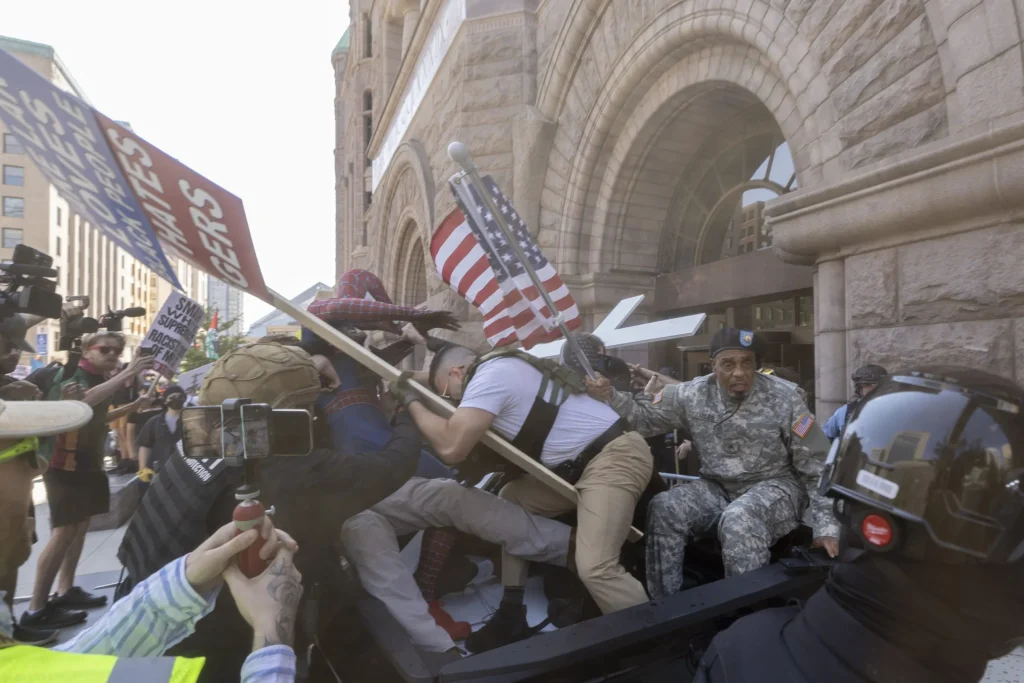
According to Minneapolis police, the vehicles moved slowly through the area, but their presence on the sidewalk immediately intensified an already volatile scene. Protesters surrounded the vehicles, objects were thrown and chemical irritants were reportedly deployed by people on both sides.
Then Spider-Man appeared.
Video captured 33-year-old William Nicholas Love, dressed in a Spider-Man costume, jumping onto the back of the pickup truck carrying Lang. Love can be seen throwing punches at Lang and attempting to take away one of the signs he was holding.
The footage quickly went viral.
Across social media, Love was celebrated as “Minneapolis Spider-Man”—a real-life superhero willing to confront a man who had arrived in the city displaying openly racist messages. Memes spread, supporters rallied behind him and a fundraiser was launched to assist with his legal expenses.
But the moment that made Love a viral figure also resulted in a criminal case.
Love has been charged through the Minneapolis City Attorney’s Office with misdemeanor fifth-degree assault involving fear of bodily harm or death. A detailed criminal complaint had not yet been released when the charge was first reported.
Lang was also arrested following the confrontation on suspicion of riot-related offenses. However, Hennepin County Attorney Mary Moriarty announced that her office would not pursue felony charges against him.
Moriarty said prosecutors reviewed extensive evidence showing communication and logistical coordination between the Minneapolis Police Department and Lang’s private security detail. Based on that evidence, her office determined there was no viable path to proving felony charges beyond a reasonable doubt.
She nevertheless condemned Lang’s conduct, calling his actions “despicable and disgusting.”
That distinction—between behavior that is morally reprehensible and conduct prosecutors believe they can prove is criminal—has done little to quiet the public response.
For many Black residents and community advocates, the outcome feels painfully familiar: a white provocateur arrives displaying racial slurs, his vehicles move onto a sidewalk crowded with protesters and police appear to protect his exit, while the man who physically confronts him becomes the person facing charges.
Police officials have said officers were attempting to de-escalate the situation and believed moving the vehicles away from the crowd was safer than making immediate arrests in the middle of the confrontation. Lang and others associated with his group were arrested later after their vehicles were stopped and impounded.
Still, images of officers forming a barrier near Lang’s vehicles created an unavoidable question: Who was being protected, and from whom?
The issue is larger than whether every action taken by Love was legally defensible. Punching someone can result in an assault charge, even when that person is carrying a racist sign. But the public frustration is rooted in the circumstances surrounding that punch.
Lang did not arrive in Minneapolis as an unknown political speaker attempting to participate in a peaceful exchange of ideas. He came with an established history of inflammatory demonstrations aimed at Black, Muslim, immigrant and Somali communities.
Earlier this year, Lang attempted to lead an anti-Islam and anti-Somali rally in Minneapolis. That demonstration was also overwhelmed by counterprotesters, who ultimately drove him from the area. He later returned to Minnesota and was charged in a separate case involving damage to an anti-ICE ice sculpture at the State Capitol.
His latest Minneapolis appearance followed the same familiar playbook: announce a deliberately inflammatory event, bring cameras, display hateful messages and wait for the confrontation that will generate attention online.
That is the danger of modern political provocation. The objective is not always persuasion. Sometimes, the confrontation itself is the content.
Minneapolis Spider-Man gave the internet a striking image: a masked Black man confronting a nationally known far-right agitator carrying racist signs. To many, it looked like the kind of justice rarely delivered through official channels.
But viral symbolism and legal accountability are not the same thing.
Love’s prosecution does not erase the racist nature of Lang’s demonstration. Lang avoiding felony charges does not mean authorities endorsed his conduct. And police efforts to prevent immediate violence do not resolve the community’s concerns about why a known provocateur was able to bring vehicles and explicitly racist materials into an already tense public gathering.
The moment now leaves Minneapolis with two competing truths.
Violence can carry legal consequences, even when directed at someone promoting hate. At the same time, communities have every right to question a system in which the person confronting racism appears to face more immediate accountability than the person who deliberately brought it into the public square.
William Love may not possess superhuman powers, but his costume turned one heated encounter into something much larger. Minneapolis Spider-Man has become a symbol of the anger, exhaustion and defiance felt by people who are tired of watching racism treated as spectacle—and tired of being told to quietly ignore it.
The courts will determine what happens to Love.
The community, however, has already begun delivering its own verdict.
Sources: FOX 9, KSTP, Minnesota Spokesman-Recorder, Bring Me The News


