


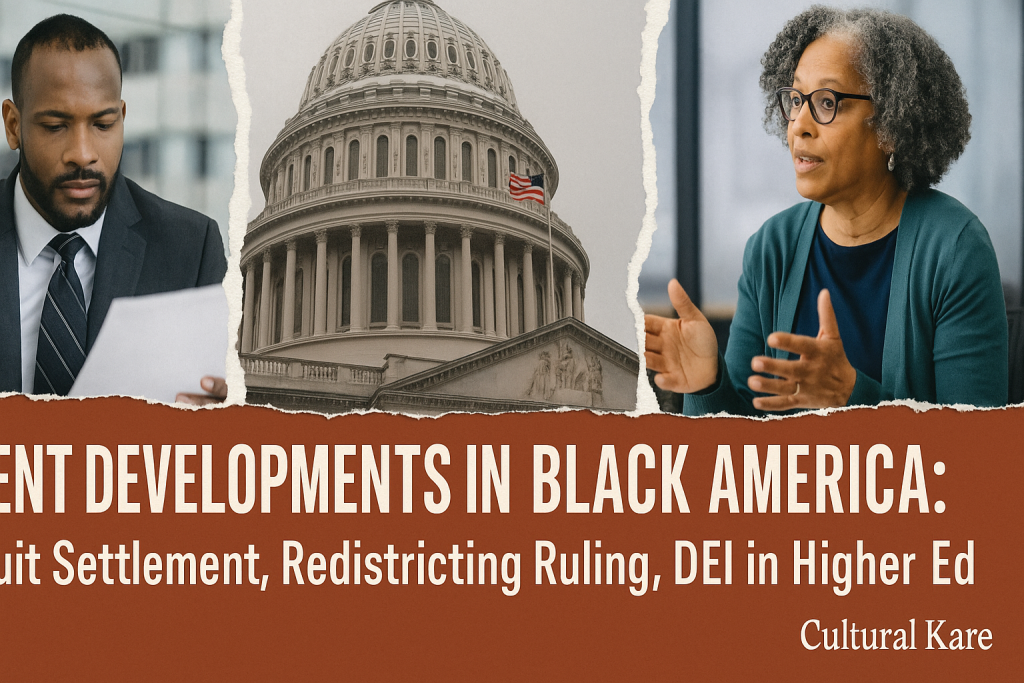
Across the United States, recent developments are highlighting urgent questions of racial justice in America, civil rights, and the ongoing struggle to dismantle systemic racism. From a major class-action lawsuit settlement to heated voting rights battles and attacks on Diversity, Equity, and Inclusion (DEI) in higher education policy, these events have far-reaching consequences for Black communities.
Merrill Lynch Settles Racial Discrimination Lawsuit with Black Financial Advisors
In the financial services industry, Merrill Lynch has agreed to a $19 million settlement in a class-action lawsuit alleging racial discrimination against Black financial advisors.
Filed in 2019, the lawsuit claimed the firm’s internal policies perpetuated systemic racism in finance by denying Black advisors access to lucrative accounts and opportunities. Plaintiffs alleged the company maintained a racial glass ceiling, limiting career advancement and contributing to the underrepresentation of Black professionals in senior roles.
While Bank of America, Merrill Lynch’s parent company, denied wrongdoing, it stated it is “pleased to resolve this matter” and reaffirmed its commitment to diversity, equity, and inclusion in its employment practices.
Advocates view the settlement as a partial victory in the fight against employment discrimination, but stress the need for broader reforms to address deep-seated bias across the industry.
Federal Judge Rejects Louisiana Redistricting Map
Meanwhile, in Louisiana, the battle over electoral fairness and voting rights continues. In early July 2025, a federal judge struck down a proposed redistricting map that would have created a second majority-Black House district.
Civil rights organizations and Black voters argued that the state’s current map amounts to racial gerrymandering, unlawfully diluting Black voting power in violation of the Voting Rights Act. By concentrating Black voters into a single district, critics say the map minimizes their influence statewide.
However, Judge Shelly Dick ruled the proposed alternative did not meet constitutional standards for compactness and respect for traditional redistricting principles. The decision represents a setback for efforts to ensure electoral fairness and racial justice in a state where Black residents make up nearly one-third of the population.
Legal experts predict ongoing litigation and appeals, as Louisiana remains a focal point in the nationwide fight over racial gerrymandering and voting rights protections.
Executive Order Targets DEI in Higher Education Accreditation Standards
Higher education is another frontline in debates over racial equity and civil rights. A new executive order signed by President Trump in 2025 targets DEI practices in higher education, with a focus on accreditation standards.
The order directs the Department of Education to review accrediting agencies that require diversity, equity, and inclusion measures, claiming such standards impose ideological conformity and threaten academic freedom. Critics see this move as part of broader anti-DEI legislation trends seeking to eliminate programs that promote educational equity and support historically marginalized groups.
Higher education leaders warn the policy could disrupt accreditation, undermine DEI initiatives, and hamper efforts to close achievement gaps. They argue diversity, equity, and inclusion policies are essential for creating equitable, supportive environments for all students.
Civil rights groups have condemned the executive order as a direct attack on racial justice in America, designed to weaken institutional commitments to DEI in higher education.
Conclusion
Together, these events illuminate the intersecting struggles over racial discrimination, employment discrimination, voting rights, and educational equity. As Black communities continue to fight for civil rights and representation, these battles underscore the ongoing challenges—and critical importance—of advancing racial justice in every sphere of American life.


