


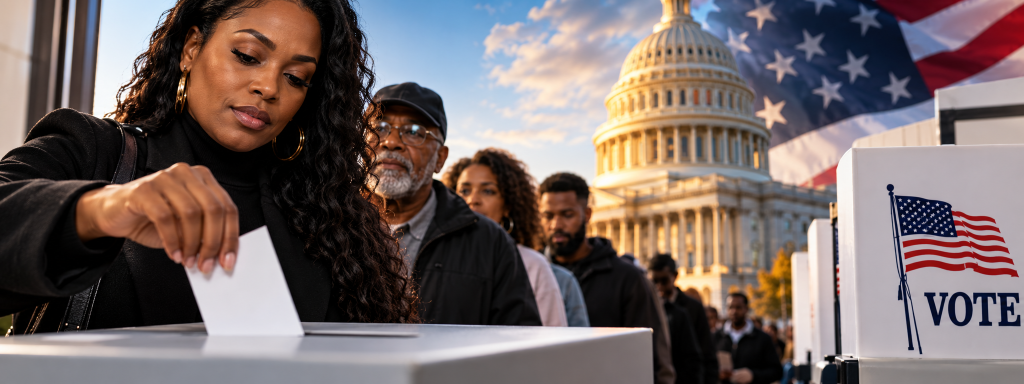
From Texas to Georgia and Wisconsin, Black voters aren’t simply participating in this election. In several of the country’s biggest races, they could help determine who holds power after November 3.
The 2026 midterm elections are approaching, and for Black America, this is not an election to overlook simply because there isn’t a presidential candidate at the top of the ballot. On November 3, voters will decide every seat in the U.S. House, roughly one-third of the Senate and key governors’ races across the country. With approximately 35 million Black Americans eligible to vote, our participation could influence several major races and, ultimately, who holds political power in this country.
Why should that matter to us? Because the people elected in November will make decisions about issues that show up in our homes long after Election Day is over. The cost of healthcare, housing and groceries, funding for our children’s schools, support for Black-owned businesses, public safety, criminal justice, voting access and the judges who interpret our laws are all affected by the people we elect. We may not follow every vote in Congress or every bill passed at a state capitol, but we live with the results.
Texas is one race to watch. Democrat James Talarico is challenging Republican Ken Paxton for the U.S. Senate in a state that has not elected a Democratic senator in decades. Texas has the largest Black eligible voter population in the country, and with Republicans currently holding a 53–47 Senate majority, a competitive race there has implications well beyond Texas.
Georgia has two races that deserve our attention. Former Atlanta Mayor Keisha Lance Bottoms is running for governor against Republican businessman Rick Jackson. A Bottoms victory would make her the first Black woman elected governor in U.S. history. Black voters represent a significant portion of Georgia’s electorate and have already demonstrated their ability to influence statewide and national elections.
Georgia’s U.S. Senate race is equally important. Democratic Senator Jon Ossoff is seeking reelection, and the outcome could help determine which party controls the Senate. His first victory came during a period of significant voter mobilization in Georgia, particularly among Black voters. Both parties understand the importance of Black turnout there, which is exactly why Black voters should understand it too.
In Illinois, Lieutenant Governor Juliana Stratton is running for the U.S. Senate against Republican Don Tracy. Illinois may not receive the same battleground attention as Texas or Georgia, but this race carries historical significance. If elected, Stratton would become only the fifth Black woman elected to the U.S. Senate in American history and could join Angela Alsobrooks of Maryland and Lisa Blunt Rochester of Delaware in the chamber.
Wisconsin also deserves attention, especially for those of us in Minnesota and throughout the Upper Midwest. Milwaukee County Executive David Crowley is running for governor against Republican Congressman Tom Tiffany. If elected, Crowley would become Wisconsin’s first Black governor. Wisconsin’s recent statewide elections have been decided by narrow margins, making voter participation particularly important.
But this conversation is bigger than whether the person running for office is Black. Representation matters, but so does policy. A Black candidate doesn’t automatically deserve the Black vote, just as one political party shouldn’t assume it owns it. We should know who is asking for our vote, what they have done, what they are promising and whether their policies actually serve our families and communities.
Black America is not a political monolith. Some of us are Democrats. Some are Republicans. Some are independents, and plenty of people are frustrated with all of them. Our priorities aren’t identical either. One family may be worried about healthcare while another is trying to buy its first home. A business owner may be thinking about taxes and access to capital while a parent is concerned about schools, public safety or the cost of childcare.
But sitting out an election doesn’t remove politics from our lives. It simply means decisions will still be made without our participation.
That is why midterms matter. Governors sign laws. Senators confirm federal judges and vote on major legislation. Members of Congress determine what legislation moves forward. State governments make decisions about schools, voting laws, healthcare, policing and economic policy. Those decisions eventually make their way from government buildings into our neighborhoods.
Texas could affect control of the Senate. Georgia could make history in its governor’s race while also helping determine Senate control. Illinois could increase Black women’s representation in one of the most powerful institutions in the country. Wisconsin could elect its first Black governor.
The candidates have one month to tell us what they plan to do with the power they’re asking us to give them.
Our responsibility is to listen, ask questions, look at their records and vote according to what we believe is best for our families and our communities.
Because whether we participate or not, somebody will be elected on November 3.
The question is whether we will have a say in who that is.
Election Day is November 3.
The candidates will spend the next month telling Black voters why they need us.
The more important question may be what we require from them before they get our vote.


