


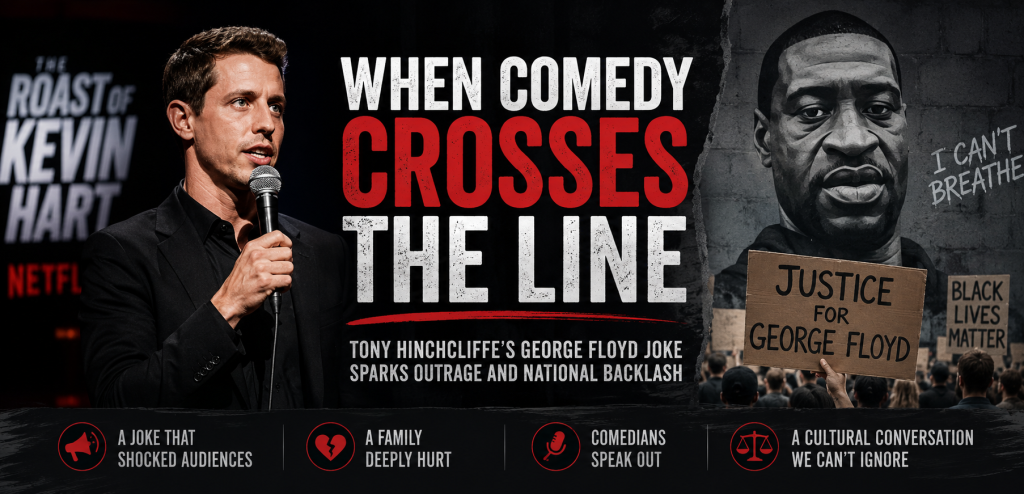
Comedian Tony Hinchcliffe is once again facing national backlash after making a controversial joke about George Floyd during The Roast of Kevin Hart — a moment that many viewers, comedians, and members of Floyd’s family described as deeply offensive and culturally insensitive.
During his roast set, Hinchcliffe referenced the circumstances surrounding Floyd’s death with a punchline that included the phrase “he can’t breathe,” a direct callback to Floyd’s final words during the 2020 police killing that sparked worldwide protests and a global reckoning around race, policing, and social justice.
For many watching, the joke was not viewed as edgy comedy. It was viewed as reopening a wound that remains painfully fresh for millions of people.
The backlash was swift.
Members of Floyd’s family and representatives connected to the foundation established in his name publicly condemned the remarks, calling them “sad for the culture” and expressing frustration that such material continues to be platformed on major entertainment stages. Critics argued that invoking Floyd’s death for comedic shock value crossed a line between satire and cruelty.
Fellow comedian Lil Rel Howery also spoke out publicly, describing the joke as “disgusting” and questioning why the audience response inside the venue appeared muted rather than outraged.
The controversy has once again reignited the long-running debate surrounding comedy, free speech, and accountability.
Supporters of roast-style comedy often argue that no topic should be considered off-limits in entertainment. Roast culture, by design, is intended to provoke discomfort, push boundaries, and challenge audiences. But critics of Hinchcliffe’s remarks argue this situation is different because the joke centered around a real-life murder that became symbolic of systemic injustice and racial trauma.
Unlike traditional roast targets — celebrities, politicians, or public figures voluntarily participating in the spectacle — Floyd was not a comedian, entertainer, or participant in the event. For many observers, that distinction matters.
The moment also highlights the growing tension within entertainment culture itself. Audiences today are increasingly questioning whether “shock comedy” is evolving or simply relying on outrage to remain relevant. As social awareness continues to shift, comedians and public figures alike are finding themselves under greater scrutiny for material that touches on race, violence, trauma, and historically painful events.
This is not the first time Hinchcliffe has faced controversy over racially charged humor. Past incidents and previous remarks involving Floyd have contributed to criticism that the comedian repeatedly returns to provocative racial material for attention and reaction.
At the center of the conversation remains a larger question society continues to wrestle with:
Where is the line between fearless comedy and harmful commentary?
For some, comedy should remain completely unrestricted.
For others, certain tragedies — especially those tied to real human suffering — should never become punchlines.
What is clear is that the reaction to this moment extends far beyond one joke. It reflects a broader cultural conversation about empathy, accountability, entertainment, and the evolving expectations audiences now place on public figures and media platforms alike.


