

By Tephanie Delaney
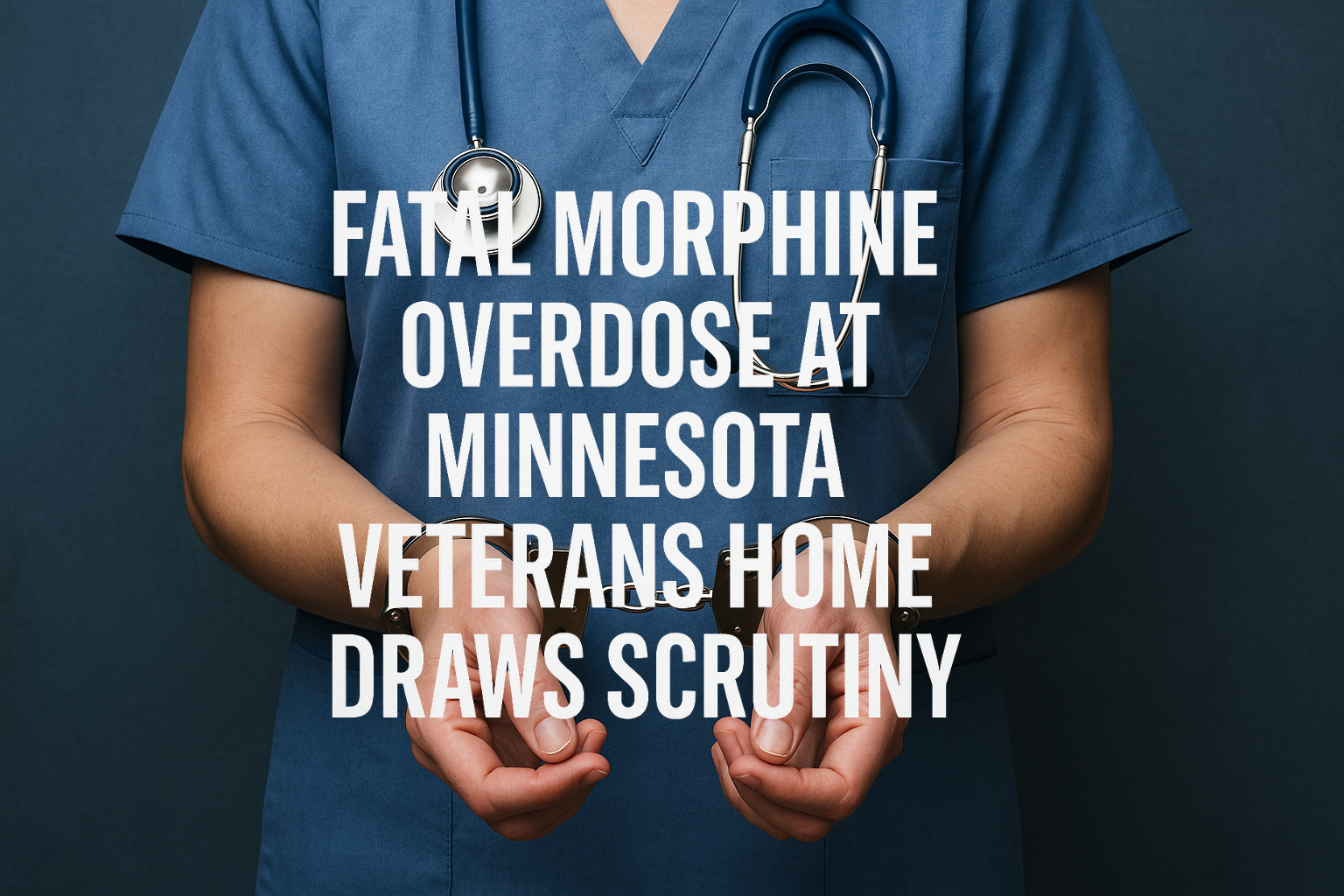
Minneapolis, MN — The death of a resident at the Minnesota Veterans Home in Minneapolis after a massive morphine overdose is sparking outrage, grief, and urgent calls for change within Minnesota’s nursing community.
According to a May 2025 findings letter from the Minnesota Department of Health (MDH), a licensed practical nurse — identified only as “LPN-A” — mistakenly administered 100 milligrams of morphine instead of the prescribed 5 milligrams. The error stemmed from confusing milligrams with milliliters, delivering a dose 20 times higher than ordered. The resident died within hours.
In keeping with its routine practice, MDH anonymized the nurse in its public report, citing the facility for “immediate jeopardy” but focusing on systemic failures rather than an individual’s identity. The nurse is no longer employed at the Veterans Home.
Perspectives From the Front Lines
To better understand how such a tragedy could happen, I interviewed four Minnesota-based nurses spanning multiple decades of experience. Their names remain anonymous, but together their perspectives offer a window into both the human factors and systemic failures at play.
One nurse pointed out that cameras are increasingly used in many long-term care facilities, but argued that they function more as documentation than prevention. “They’re not reviewed in real time,” she explained. “They’re looked at only after something goes wrong. This isn’t going to bring a family’s loved one back. What we need are safeguards that stop mistakes before they ever reach the bedside.”
Another nurse advocated for hospital-style safeguards, such as pharmacy-prepared, pre-labeled doses that are scanned into a patient’s electronic chart. “That’s the system in my hospital,” she explained. “The medication is matched to the patient through a scan, and the nurse cannot proceed without confirmation.”
A third nurse, who regularly works 12- to 16-hour shifts, acknowledged the toll of exhaustion but said the error should still have been instinctively obvious. “Even when I’m dead tired, it’s instinct. You know when you’re drawing too much morphine — the number of vials alone should raise red flags.”
From yet another perspective came a sharper critique: complacency. “Some nurses get into a rhythm and start feeling like they’ve done it so many times, they don’t need to follow every step,” one said. “That’s how protocols get skipped. That’s how mistakes happen.”
The Nurse’s Role: Levels of Nursing
The MDH report identifies the staffer as an LPN, or Licensed Practical Nurse — a mid-level credential in nursing. But within the profession, there are multiple tiers of training and responsibility, each carrying different scopes of practice:
- CNA (Certified Nursing Assistant): Entry-level caregivers who provide basic daily care such as bathing, feeding, and mobility assistance. CNAs are not licensed to administer medications.
- LPN (Licensed Practical Nurse): Typically complete a one-year program and pass the NCLEX-PN exam. LPNs can administer medications, including narcotics, but they do so under the supervision of an RN or physician.
- RN (Registered Nurse): Hold a two- or four-year degree in nursing and must pass the NCLEX-RN exam. RNs carry broader responsibilities, including performing complex assessments, supervising LPNs and CNAs, and creating care plans.
- Nurse Practitioner (NP): Advanced nurses with a master’s or doctoral degree who can diagnose conditions, prescribe medications, and provide treatment plans. NPs often practice with significant independence, similar to physicians in many settings.
This distinction has sparked debate among those I interviewed. Several argued that high-risk medications like morphine should be reserved for RNs and above. “Maybe only a nurse with higher training should be able to administer these types of drugs,” one Minnesota nurse said. “That could be a safeguard in itself.”
While LPNs are legally permitted to administer morphine in Minnesota, some nurses believe restricting narcotics to RNs, nurse practitioners, or physicians could add an essential layer of protection for patients — especially in settings where vulnerable populations, such as veterans or the elderly, are receiving end-of-life care.
A Seasoned Nurse Calls for Tougher Penalties
One of the nurses I spoke with — a seasoned professional with more than 20 years of experience — argued that consequences for fatal medication errors are too light. “In many cases, the penalties just include a loss of license,” she said. “That doesn’t feel fairly weighed when a patient is gone forever.”
Under the Minnesota Nurse Practice Act (Minn. Stat. § 148.261), the Board of Nursing can revoke, suspend, limit, or condition a nurse’s license, impose civil penalties of up to $10,000 per violation, or issue reprimands and mandatory retraining. Institutions are also required to report serious incidents. But critics say these penalties often fail to match the gravity of a patient death.
Civil lawsuits remain an avenue for families — Minnesota has no cap on malpractice damages — and punitive damages are possible in cases of gross negligence. Still, the line between tragic mistake and criminal liability is rarely crossed, and disciplinary measures tend to focus on professional practice rather than legal punishment.
What Happens Next
The Veterans Home has since retrained staff on medication transcription, electronic chart verification, and double-checking narcotic dosages. MDH will continue to monitor compliance.
Yet for the four nurses who spoke out, retraining is only part of the solution. They believe technology-driven verification systems, stronger accountability measures, and cultural shifts within nursing — to resist complacency and over-reliance on routine — are all essential if another tragedy is to be prevented.
As one nurse summed it up: “We can’t bring this veteran back. But we can make sure another family doesn’t have to live this nightmare.”